By Analyst Team · Updated 2026-07-11 · 9 min read
Choosing an ip-tv provider in 2026 feels like walking through a digital minefield. You want reliable streaming, fair pricing, and legal peace of mind — but the market is flooded with shady resellers and conflicting reviews. This complete guide cuts through the noise to give you a step-by-step framework for selecting a reputable ip-tv provider that matches your specific needs, whether you are after live sports, international channels, or just a cheaper alternative to cable.
By the end of this article, you will understand exactly what an IP-TV provider does, how the technology works behind the scenes, the honest trade-offs you must accept, and a proven checklist to evaluate any service before handing over your payment details. We also answer the most common long-tail questions from real users — including best ip-tv provider 2026, how to choose an ip-tv provider, and reliable ip-tv provider no buffering.
LIMITED TIME AVAILABILITY
Unlock Full ip-tv provider Access
Secure special promotional rates instantly before the window closes. Lock in your pricing model today before plans return to standard regional metrics.
What Is an ip-tv provider Exactly?
An ip-tv provider is a company or service that delivers live television channels and on-demand video content over an internet protocol network — essentially your broadband connection — instead of traditional satellite, cable, or terrestrial broadcast signals. The term "IPTV" stands for Internet Protocol Television, and the provider acts as the middleman between content distributors (networks, studios, broadcasters) and you, the end user.
Unlike streaming giants like Netflix or Hulu that offer only on-demand libraries, most ip-tv providers specialize in live linear television. This means you get real-time broadcasts of news channels, sports events, international programming, and premium movie networks — often for a fraction of the cost of a traditional cable bundle.
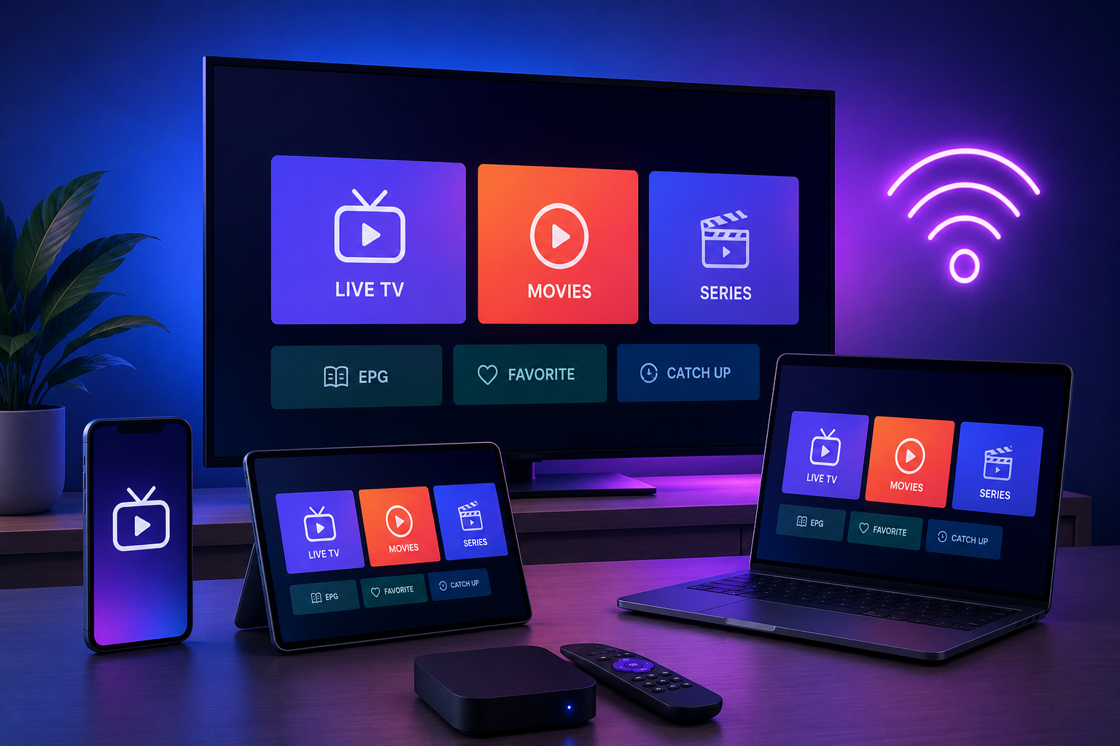
A legitimate provider maintains legal agreements with content owners and pays licensing fees. However, a significant portion of the market operates in a legal gray zone, reselling unauthorized streams. Understanding this distinction is critical when you evaluate any potential ip-tv provider. The image above shows a typical family setup where an ip-tv service replaces a traditional cable box with a simple app installed on a smart device.
How IP-TV Technology Works
You do not need to be a network engineer to understand the basics. Behind every reliable ip-tv provider is a straightforward chain of data transmission. Here is how it works in four simple steps:
Step 1: Content acquisition. The provider sources live feeds from broadcasters via satellite, fiber feeds, or direct agreements. This raw video is encoded into a digital format (usually H.264 or H.265) and compressed to reduce bandwidth requirements.
Step 2: Server distribution. The compressed streams are sent to powerful servers hosted in data centers. These servers are the backbone of any ip-tv service — they handle thousands of simultaneous viewers without dropping frames. The geographic location of these servers directly impacts your latency and buffering.
Step 3: Middleware and channel list. The provider runs a middleware platform (like Xtream Codes or Stalker Portal) that organizes the channels into a readable electronic program guide (EPG). This is the interface you scroll through on your screen.
Step 4: Your device decodes the stream. Your smart TV, Android box, Fire Stick, or smartphone receives the encrypted data via the internet. An IPTV player app (such as TiviMate, IPTV Smarters, or VLC) decrypts and decodes the video into smooth visuals on your screen.
The entire process happens in under two seconds when everything is optimized. Delays occur when any link in this chain is weak — slow internet, overloaded servers, or outdated decoding hardware.
Concrete Benefits for Users
Why would someone switch from traditional cable or satellite to an ip-tv provider? The advantages are tangible and measurable for most households.
Significant cost savings. The average cable bill in the United States exceeds $110 per month. A premium ip-tv subscription typically ranges between $10 and $25 per month, offering similar or larger channel counts. Even annual plans rarely exceed $150, representing a 60-80% reduction.
Massive channel variety. Most ip-tv providers offer 1,000 to 8,000 channels from dozens of countries. You gain access to international content that cable companies rarely carry — Arabic, Indian, Filipino, French, German, and Latin American programming are common inclusions.
Multi-device support. A single subscription often works on up to five devices simultaneously. You can watch live sports in the living room while your partner streams a movie on a tablet in the bedroom and your kids watch cartoons on a PC. Cable companies charge extra for each additional box.
Video-on-demand libraries. Many providers bundle thousands of movies and TV series with their live TV packages. This content is often updated weekly, rivaling the depth of services like Netflix and Hulu in certain genres (particularly action, Bollywood, and classic cinema).
Catch-up and time-shifting. Reputable services offer a catch-up feature that lets you replay any program aired in the last 24 to 72 hours. This is invaluable for sports fans who cannot watch a game live at 3 AM local time.
Honest Limitations You Must Accept
No technology is perfect, and ip-tv providers have real drawbacks that sales pages will never highlight. Here is the unfiltered reality.
Internet dependency. If your broadband connection drops below 15 Mbps (for HD) or 50 Mbps (for 4K), quality suffers immediately. Buffering, pixelation, and frozen screens become common during peak hours. Traditional cable does not have this vulnerability.
Legal ambiguity. A large percentage of ip-tv providers operate without proper licensing agreements. Using an unauthorized service can expose you to risks — ISP throttling, device blocking, or even legal notices in some jurisdictions. Always verify that your chosen ip-tv provider is a legitimate reseller with documented content-rights agreements.
Service instability. Unlike cable companies that maintain 99.9% uptime, smaller ip-tv providers can disappear overnight. Their servers get shut down by authorities, they face payment processor issues, or they simply decide to stop operations. You lose your subscription investment instantly.
User interface inconsistency. Not all IPTV apps are polished. Some providers force you to use third-party players that require manual configuration, EPG setup, and VPN integration. This technical overhead frustrates less experienced users.
No local channels by default. Most ip-tv providers do not include over-the-air local affiliates (ABC, NBC, CBS, Fox) in their packages unless they specifically negotiate for them. You may need an antenna as a backup for local news and live sports broadcasts.
Unlock complete high-definition information and priority access packs.
Claim This Special Offer for ip-tv provider →ip-tv provider vs Cable TV: Honest Comparison
The table below breaks down the critical differences between a standard ip-tv provider and traditional cable television. Use this to decide which option fits your household profile.
| Feature | ip-tv provider | Cable TV |
|---|---|---|
| Monthly cost | $10 – $25 | $80 – $150+ |
| Channel count | 1,000 – 8,000+ | 100 – 300 |
| Device flexibility | Phones, tablets, TVs, PCs | Limited to expensive boxes |
| Internet required | Yes – 100% dependent | No – coaxial/satellite only |
| Recording options | Catch-up and cloud DVR | Physical DVR with fees |
| Legal protection | Varies – must verify | Fully licensed |
| Local channels | Often missing | Included in basic |
| Contract term | Monthly or annual (no lock-in) | Typically 1-2 year contract |
Who Is an ip-tv Provider Best For?
Not every viewer should abandon cable. Here are the specific user profiles that gain the most value from switching to an ip-tv provider:
The international viewer. If you are an expatriate or immigrant who wants live news and entertainment from your home country, an ip-tv provider is unmatched. Cable rarely offers more than a handful of international channels, while IPTV packages often include 100+ channels from specific regions.
The sports fanatic. Dedicated sports packages on cable cost $40-60 extra per month. A single ip-tv subscription covering all major sports networks (ESPN, beIN Sports, Sky Sports, DAZN) costs the same as the base fee alone. Fans of less mainstream sports like MMA, rugby, or cricket find better coverage through IPTV.
The cord-cutter on a budget. Retirees, students, and households trying to reduce monthly expenses benefit most. Replacing an $150 cable bill with a $15 IPTV subscription saves over $1,600 annually.
The multi-device household. Families with multiple televisions and portable devices save significantly because one IPTV plan covers all screens without rental fees for extra cable boxes.
The DVR-heavy user. If you rarely watch live television but rely on recordings and on-demand content, IPTV catch-up features and VOD libraries provide a Netflix-like experience without losing access to live events.
How to Get Started: Practical Numbered Steps
Follow these eight steps to find, test, and activate a reliable ip-tv provider without wasting money or falling for scams.
Step 1: Assess your internet connection. Run a speed test at speedtest.net. You need at least 25 Mbps download speed for stable HD streaming and 50 Mbps for 4K content. Check ping as well — anything above 100ms causes noticeable delay on live streams.
Step 2: Research providers on Reddit and Trustpilot. Subreddits like r/IPTVReviews, r/IPTV, and r/IPTVDiscussions contain candid user feedback. Look for providers with at least six months of active positive reviews. Avoid accounts with only glowing, generic praise.
Step 3: Request a 24-hour trial. Reputable providers offer free or paid trials (typically $2-5 for 24-48 hours). Use this window to test streaming quality during peak evening hours in your region. If they refuse a trial, move on.
Step 4: Verify legal status. Ask the provider directly whether they hold content distribution licenses. Legitimate services will tell you their legal structure. Gray-market providers dodge the question. If you are in the EU, UK, or US, using an unlicensed provider carries real risk.
Step 5: Test EPG functionality. During your trial, check whether the electronic program guide populates correctly for the channels you care about. Many providers have poor EPG coverage for niche channels, making navigation frustrating.
Step 6: Choose a one-month plan first. Even if the provider offers a steep discount for an annual subscription, start with one month. This gives you an exit window if service quality declines or the provider shuts down.
Step 7: Set up your device. Install a compatible IPTV player app on your preferred device. Popular options include TiviMate (Android TV), IPTV Smarters Pro (all platforms), and GSE Smart IPTV (iOS). Enter the playlist URL or login credentials provided by your ip-tv provider.
Step 8: Configure a VPN (optional but recommended). If you choose a gray-market provider, a good VPN hides your IPTV traffic from your ISP, preventing throttling. Even with legal providers, a VPN can reduce buffering by circumventing ISP traffic shaping during peak hours.
Final Subscription Window:
Main Offer Today →Affiliate Disclosure: Clicking this secure link verified by our network supports our team through standard partnership terms at zero extra cost to your invoice.
Frequently Asked Questions
What is the best ip-tv provider 2026?
The "best" ip-tv provider in 2026 depends on your region and content preferences. However, services that offer dedicated 4K streams, EPG coverage for local channels, and active support communities on Reddit consistently rank highest. Look for providers with at least three server locations to minimize buffering. We recommend testing three candidates with short-term plans before committing annually.
How do I choose an ip-tv provider without getting scammed?
Start by reading ip-tv provider reviews reddit threads from the past six months. Avoid providers that only accept cryptocurrency or untraceable payment methods — legitimate services offer PayPal or credit card processing. Always test a 24-hour trial before paying for a full subscription. If the provider has zero social media presence or website transparency, walk away.
Can I get an ip-tv provider for sports only?
Yes, many ip-tv providers offer sports-specific packages that include all major leagues (NFL, NBA, Premier League, UEFA Champions League, F1, UFC) without news or entertainment channels you do not watch. These packages typically cost $8-15 per month. Confirm that the provider includes local sports networks (like Bally Sports or NBC Sports regional) if you follow a specific local team.
What is the cheapest ip-tv subscription available?
Prices vary dramatically, but legitimate cheapest ip-tv subscription options start around $8-10 per month for basic packages with 500-800 channels and limited VOD. Annual plans can drop as low as $50-70 total. Be extremely cautious about anything under $5 per month — these are almost certainly illegal resellers who will disappear within weeks.
Where can I read reliable ip-tv provider reviews on Reddit?
The most active subreddits for ip-tv provider reviews reddit are r/IPTVReviews, r/IPTV, and r/IPTVwithreviews. Sort posts by "Top" over the past year to find the most upvoted reviews. Be skeptical of brand-new accounts posting glowing reviews — many are paid shills. Cross-reference any provider you find with comments on r/IPTVdiscussions for balanced opinions.
Where can I buy IPTV legally?
To where to buy ip-tv legally, look for providers that openly state they are content distributors with licensing agreements. Some legitimate options include national telecom providers (like AT&T TV, Swisscom, BT TV) that offer IPTV as a delivery method for their cable-equivalent services. Independent providers that are transparent about their legal structure and accept mainstream payment processors are also worth considering.
How do I find a reliable ip-tv provider with no buffering?
A reliable ip-tv provider no buffering guarantee is rare, but you can identify services that minimize buffering by asking three questions during your trial: What is your server-to-user ratio? Do you have CDN delivery? What is your monthly uptime guarantee? Providers with load-balanced servers across multiple continents and at least 500 Mbps per user capacity typically deliver buffer-free 1080p streams even during peak hours.
Is IPTV service vs cable TV actually cheaper when you factor in internet costs?
When comparing iptv service vs cable tv, you must include internet costs. Cable TV works independently of internet; IPTV requires a broadband connection that costs $40-70 per month. However, most modern households already pay for internet, so the marginal cost of IPTV is just the subscription fee. Total cost: internet ($55) + IPTV ($15) = $70 vs cable alone ($110). IPTV still saves $480 annually.